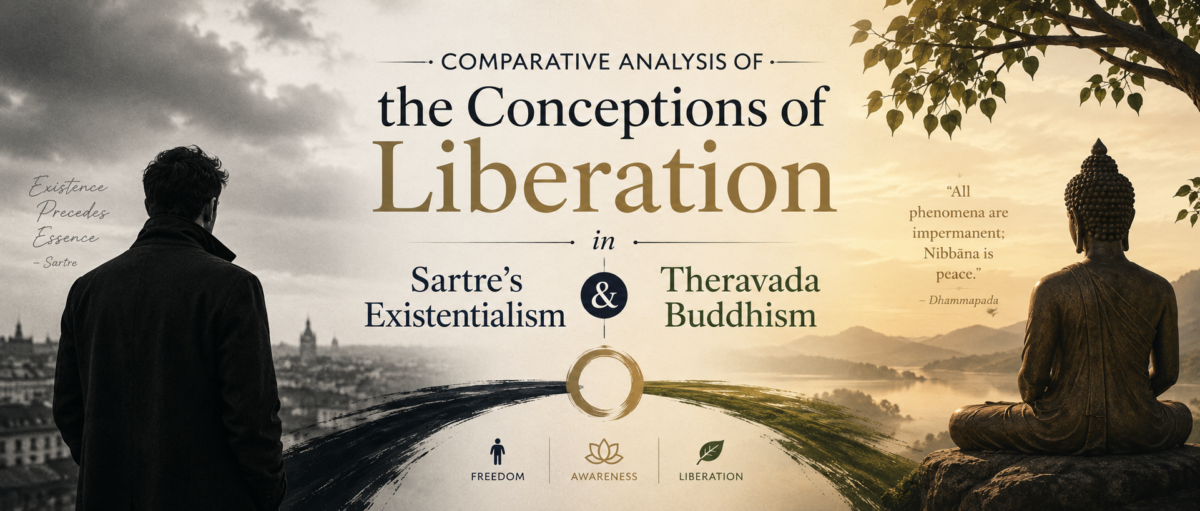
Have you ever thought that the freedom you have in your hand is only an illusion? The idea of freedom or liberation can be seen in different philosophies. Jean-Paul Sartre’s Existentialism and Theravada Buddhism are also the two philosophical concepts that approach the conceptions of liberation from different perspectives. While Sartre’s existentialism revolves around individual freedom and responsibility from Western philosophy, Theravada Buddhism, one of the oldest forms of Buddhism, emphasizes the elimination of suffering and attaining enlightenment from Eastern philosophy. Even though both philosophies navigate a common purpose for liberation, the philosophical foundations, the description of “self” and liberation, and how liberation can be achieved can be observed differently.
Before Sartre’s Existentialism, Plato and Aristotle, the ancient Greek philosophers stated that everything has its own essence – “a certain set of core properties that are necessary, or essential for a thing to be what it is.” (CrashCourse, 2016). To have a better understanding, a great example is that it does not matter whether a book has a yellow cover or a blue cover. But, if it did not have pages, it would not be a book anymore. What made the book be defined as its functions are the pages; therefore, the pages are the essential properties of a book. Both Plato and Aristotle believed that essence comes before everything, in other words, the essence of human beings comes before they are even born. Therefore, it can be said that people need to adhere to their essence to be good human beings. In the late 1800s, some philosophers started to ask questions about the idea that we are instilled with any essence or life purpose. French Philosopher Jean-Paul Sartre questioned that what if we exist without any essence and it is our responsibility to find out what essence means to us. This became the idea for Sartre’s existentialism, which claims that “existence precedes essence” (CrashCourse, 2016). According to Bakewell (2016), Sartre said “Having found myself thrown into the world, I go on to create my own definition (or nature, or essence), in a way that never happens with other objects or life forms.” This reflects the meaning of essence from the perspective of an existentialist that human beings exist first and should find out their essence through a lot of choices and actions. For me, when I take a look back from the perspective of traditional philosophy, essence precedes existence. For example, in the case of a chair, the purpose of a chair is first considered before it is made. Therefore, I believe this idea is so much like the chicken-and-egg dilemma.
On the other hand, Theravada Buddhism derived from the philosophies and teachings of Siddhartha Gautama, the Buddha around the 5th century B.C.E. In Buddhism, life is a cycle of birth, death, and rebirth – “Samsara” (Buddhism, n.d.). Therefore, Samsara is the sufferings of the cyclical existence, and liberation from existence is escaping from “Samsara.” Bodhicharya Dharma Channel (2020) stated that Samsara is the state of feeling deluded as people do not see things as they are, always occupied with self-centeredness and selfishness. We will not be free as long as we are in Samsara – a never-ending cycle of suffering and pain.
One of the distinct facts of existentialism, which can also be found in the approaches of Theravada Buddhism, is the description of the “self.” At this point, the “in-itself” and the “for-itself”, two descriptions of ‘self” in existentialism, can be expressed as the object of consciousness and the awareness of consciousness (20th WCP: Notions of Selflessness in Sartrean Existentialism and Theravadin Buddhism, n.d.). For example, a tree can be “in itself” but cannot be “for itself” simply because it cannot be aware of consciousness. While the “in-itself” can be perfect in its existence, the ‘for-itself” can bring consciousness. Therefore, consciousness is free to create its own essence along with the responsibility. Such kind of realization that one has to make choices – even not choosing anything is choosing something is called anguish. In contrast to anguish, “bad faith” arises when an individual refuses to be free and takes its own responsibility. This reminds me of a movie called “Bruce Almighty”, in which Bruce was blessed to receive the power of God since he put all of his bad luck and misfortunes into God. Despite having the divine powers, he could not stop doing the wrong things. He realized that radical freedom is accepting things just the way they are, taking responsibility for the choices, and attempting to fulfill life’s purpose. Like Bruce, when we are entirely authentic to ourselves with the fullest potential, the radical freedom that comes along with the responsibilities can be achieved in the end.
Conversely, the existence of a being is best characterized by “Three marks of existence”- impermanence (anicca), suffering (dukkha), and non-self (anatta) in Theravada Buddhism. According to Buddha, appreciating these three marks of existence is essential to attaining liberation in life. Impermanence in existence describes nothing is permanent as there is nothing in life to which one can cling (The Three Marks of Existence – Buddhism for Beginners – Tricycle, 2022). Everything in existence has to go with the process of birth and break up so-called impermanence (anicca). This reminds me of my grandma who used to say, “There are only two things in life – you exist and you disappear” when I was little. What suffering in existence (dukkha) expresses is that life is full of dissatisfaction. Even if you think you are satisfied at the moment, your desire will not be fulfilled over a period of time. Suffering does not only mean pain, unhappiness, and disappointment, rather it means the endless desires and pleasures of living creatures. The best example to describe endless desires is that rich people want to get richer and richer. Hence, people say that the more you get, the more you want. The third mark of existence, which is distinct from Sartre’s idea of existentialism, refers to the fact that the experience of “I” or singular being is an illusion since there is no self throughout the life of every being. What we call the “self” is only a collection of the five heaps of clinging – form (rupa), sensations (vedana), perceptions (samjna), Mental Formations (sanskara), and consciousness (vijnana). Unlike existentialism, Buddhism holds the idea that “external reality is as non-existent as the self” (20th WCP: Notions of Selflessness in Sartrean Existentialism and Theravadin Buddhism, n.d.). Thus, Buddhism urges individuals to recognize the reality of the non-existence of self to obtain radical freedom.
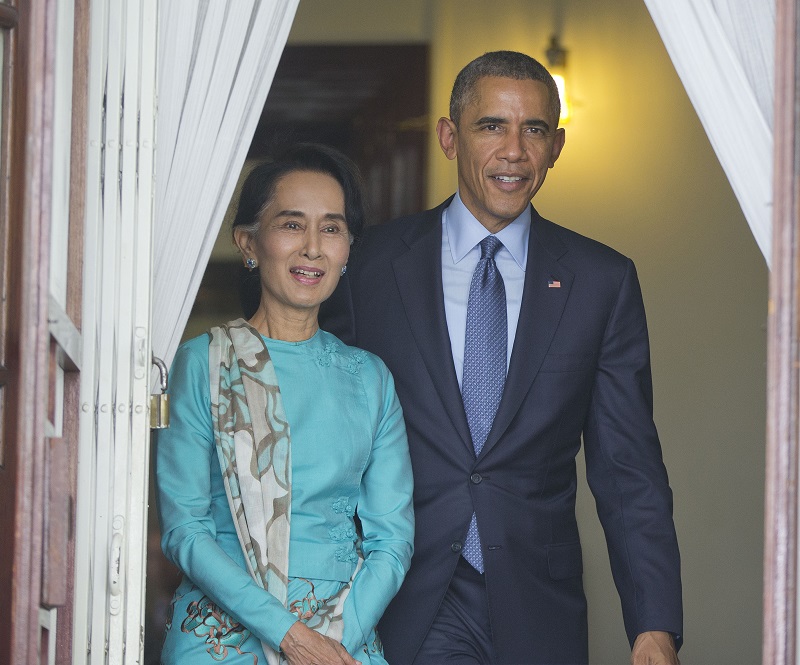
According to Einzelgänger (2020), Sartre’s nature of freedom has a few similarities with Buddhism despite the differences. In existentialism, freedom is directly related to choices and the burden of responsibility. Einzelgänger (2020) stated, “We are free to choose what we do, but the effects of our choices will always resonate between ourselves and the environment.” This phenomenon is similar to the principle of karma or the law of Cause and Effect from Buddhism – “You reap what you sow”. In a well-known book called “The Chips Are Down” by Jean-Paul Sartre, a woman called Eve and a man called Pierre meet each other in a park shortly after their death. They were the spirits that can go around people but they are invisible to the people. They were free to go wherever they wanted to go despite the limitations of interaction with the living. Even though they wanted to fix the situations they left before they died, they came to a realization that freedom does not mean they are free and they were not able to escape from the past even after the chance to return to life. This reminds me of the moment that our national leader, Daw Aung San Su Kyi was given choices to make between going back to the UK and being detained in their house. When the captain told her that she had the freedom to choose from those two choices, she replied, ‘What kind of Freedom is that?” Despite the fact that freedom has a lot to do with choices, the choices should not be given by others. Therefore, freedom in existentialism is real, and radical absolute freedom comes with absolute responsibility, which is so much like a never-ending cycle.
In contrast to the idea of freedom in Sartre’s Existentialism, freedom in Buddhism is escaping from Samsara while acknowledging the three marks of existence, which apply to all conditions of living beings. In order to achieve liberation, one should also acknowledge the four noble truths: “(1) all in the world is dukkha (suffering), (2) there is an origin to dukkha (samudaya), (3) there is a cessation to dukkha (nirodha), and (4) there is an eightfold path which leads to this cessation (astanga narga)”(20th WCP: Notions of Selflessness in Sartrean Existentialism and Theravadin Buddhism, n.d.). A famous quote of Buddha, which has been used to describe the idea of suffering, is “You can only lose what you cling to.” Everyone suffers because of the attachment they hold in their hearts. To further clarify the concepts, one should let go of the attachment in order to obtain liberation, often known as “nirvana.”If liberation is the door of freedom, the four noble truths show the key to unlock the door while freedom in existentialism is much similar to a runway circle.
As was mentioned previously, the four noble truths show there is a way to achieve Nirvana, the ultimate goal of liberation. An eightfold path or a set of guidelines to achieve Nirvana, in which wisdom (panna), morality (stla), and concentration (samadhi) are the essential categories, can be divided into eight steps: Right view, Right intention, Right speech, Right action, Right livelihood, Right effort, Right mindfulness, Right concentration (The Three Marks of Existence – Buddhism for Beginners – Tricycle, 2022). If suffering is the disease, the eightfold path is the medicine to cure it. As the eightfold path avoids extremes of self-acceptance and self-denial, Buddha defined it as “the middle way.”
Unlike Buddhism, Sartre’s liberation in existentialism does not have an ultimate goal; instead, it urges us to live authentically. The reason behind this is that existentialists believe in the idea of the absurd that the world is meaningless. There is no such thing as good or bad in absurdity. In other words, there is no good or bad person or good or bad situation. Whatever happens, it happens anyway. Hence, we are living in a place where we are looking for meaning in a meaningless world, which means there are no guidelines or moral codes. The best thing people can do is to live authentically – taking control over our perspectives and reactions in response to the actions and opinions of others and accepting who we truly are. The final destination of existentialism can be observed in the film “Barbie” directed by Greta Gerwig, in which Margot Robbie as a Barbie got a chance to enter the real world, where she had an existential crisis. She kept questioning herself, “What was I made for?” When she embraced herself and accepted things as they were, she was able to find her own essence and create meaning in an absurd world.
To summarize, the conceptions of liberation in Sartre’s Existentialism and Theravada Buddhism provide different standing points in terms of the roots of philosophies. Sartre’s Existentialism discusses the existence and essence that people exist before they find out their life purpose while Theravada Buddhism states that life is full of sufferings and it is not easy to escape from reincarnation or the process of death and birth. Moreover, Theravada Buddhism provides insights into the existence of beings that impermanence (anicca), suffering (dukkha), and non-self (anatta) require to be acknowledged if one wants to attain liberation. What is crucial is the idea of non-self. Buddha said there is no singular being in the life of every creature, yet Sartre’s Existentialism explains the description of ‘self’ as simply recognizing things as they are along with the responsibility for the actions that people do. Additionally, Freedom in existentialism is directly related to the choices we make, but freedom in Buddhism is acknowledging the four noble truths. Even though the ultimate goal of liberation in Buddhism, also known as Nirvana, is attainable by following the eightfold path, there is no such final destination for liberation in existentialism. Existentialism only urges people to live authentically in their lives and find their own purpose. Therefore, exploration of the meaning of life from the perspectives of Sartre’s existentialism and Theravada Buddhism can be more than what we expect to realize.
References
20th WCP: Notions of Selflessness in Sartrean Existentialism and Theravadin Buddhism. (n.d.). https://www.bu.edu/wcp/Papers/Reli/ReliLee.htm
Bakewell, S. (2016). At the existentialist café: Freedom, Being, and Apricot Cocktails. Random House.
Bodhicharya Dharma Channel. (2020, December 3). 12. What does ‘liberation’ in Buddhism mean? | Answers for Beginners | Ringu Tulku Rinpoche [Video]. YouTube. https://www.youtube.com/watch?v=1Wbashkgqx0
Buddhism. (n.d.). https://education.nationalgeographic.org/resource/buddhism/
CrashCourse. (2016, June 6). Existentialism: Crash course Philosophy #16 [Video]. YouTube. https://www.youtube.com/watch?v=YaDvRdLMkHs
Einzelgänger. (2020, January 30). The Tragedy of Freedom | Jean-Paul Sartre [Video]. YouTube. https://www.youtube.com/watch?v=ZwwiqQBFsJs
The three marks of existence – Buddhism for Beginners – Tricycle. (2022, April 27). Buddhism for Beginners. https://tricycle.org/beginners/buddhism/the-buddhas-three-marks-of-existence/

